
2026 Credentialing Requirements
Credentials can be generated at end of year if assessment and moderation requirements are met.
Summary of assessment requirements for credentials in 2026:
-
Min 2 teacher judgements per competency
-
Min 3 competencies
-
Plus 1 culminating assessment (conducted in Term 3)
NOTE: Assessments conducted in Semester 1 and Semester 2 will both contribute towards credentials. Ruby operates in semesterly assessment periods, two a year. A Ruby assessment has these controlling parameters:
-
Assessment period
-
Teacher
-
Student
-
Competency
If any parameter is different, Ruby will consider it as a different assessment. If all four parameters are the same, Ruby will consider it the same assessment and teachers will override their original assessment.
The subject taught (the context for the assessment) is not in the above parameters. Ruby goes off what a teacher has observed of the learner, not limited to the one classroom context.
Please read the 2026 Credentialing Guidelines below to understand all requirements.
Support Resources for Credentialing
2026 Warranting Framework:
Toward the new grammar of schooling
The Melbourne Metrics Warranting Framework forms the basis for decisions to co-issue warranted credentials to learners in schools and for schools to recognise their own progress against common and trusted standards.

-
CREDENTIALING SCHOOLS: Use this self-audit tool as a key component of the 2026 warranting process.
-
NON-CREDENTIALING SCHOOLS: Use this self-audit tool to unpack and plan for progress towards the new grammar.
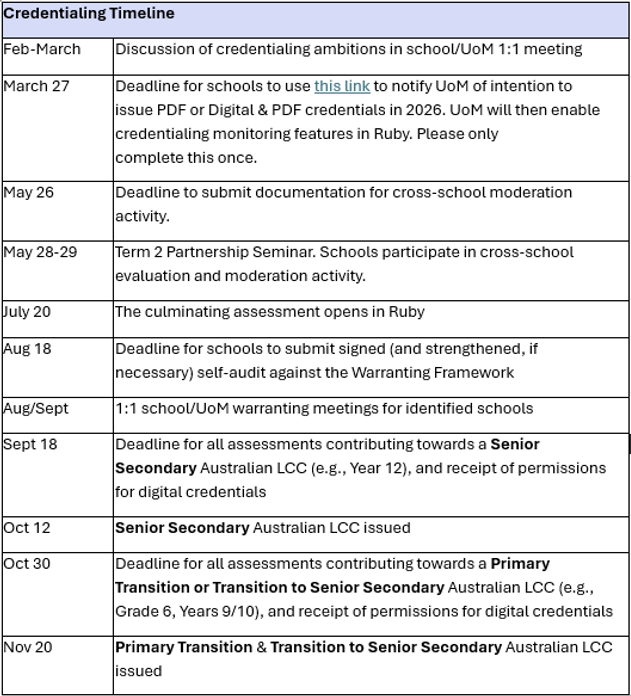
Cross-School Moderation: May 29 2026
In triad groups, each school will share and gain feedback on:
-
where it currently places its practices on all standards within the self-audit tool
-
the evidence it has to support the judgement it has made for Standard #2: LEARNING DESIGN FOR BREADTH & DEPTH
ALL SCHOOLS should provide their documentation for cross-school moderation here by May 26.